
Business
Gold loans are now gold mines for India's Financial Enterprises
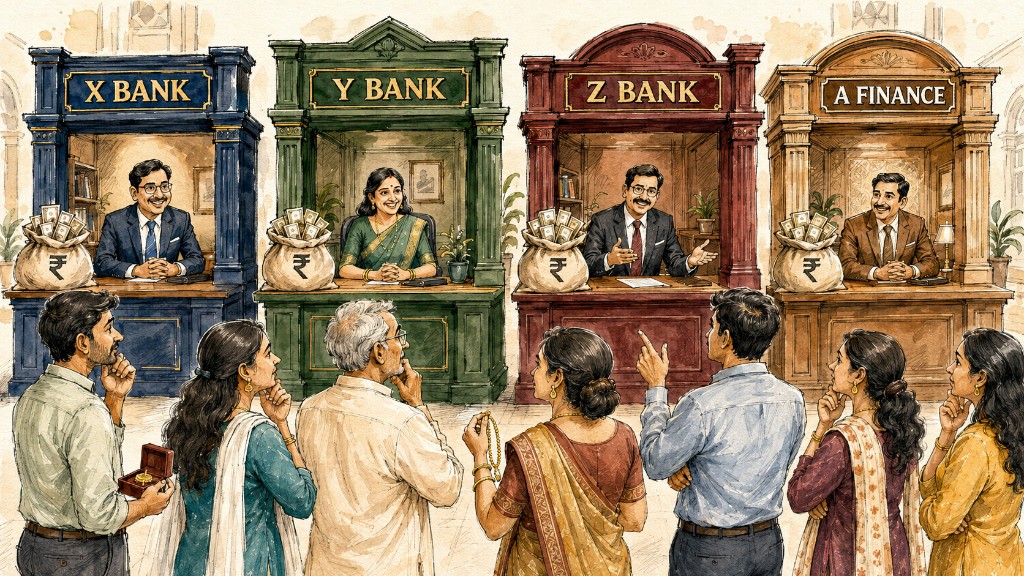
Gold always occupied a special place in Indian households. It is a glittering ornament, a financial safety asset during bad times that earned emergency money. Now, in the context of the renewed gold price episode, India is witnessing a surge in gold loan institutions.
The sharp rise in gold prices and the enormous gold holdings by millions of households are attracting new players into the gold loan market.
After the recent spike in gold prices, several new financial entities entered into the country's gold loan market.
From prestige asset to provider of emergency liquidity
From the household angle, gold has twin uses in India's ornament-oriented family culture. Besides its ornamental value, it can be quickly converted into liquid money.
From the angle of the lender, household gold holding is even more important. Here, it is a safe collateral, which fights inflation, loss of loan value; besides having tremendous liquidity.
In a country where formal lending institutions can't assess the creditworthiness of millions of households, gold becomes a safe asset to back lending.
Millions of rural borrowers including households, farmers, self-employed workers, small businesses etc. don't have salary slips or audited accounts to avail formal loans. Given that conventional lenders like banks avoid this vast majority of potential borrowers.
Gold here gives the safe asset backing for lenders.
Gold as the attraction in the retail loan market
The growth of the gold loans has been extraordinary. According to the RBI'S Financial Stability Report (June 2026), gold loans have emerged as the largest category within non-housing retail loans. The segment has recorded a growth rate of 42.4%, nearly double the growth rate of non-housing retail loans.
According to the RBI, outstanding bank loans against gold jewellery had surged to Rs 3.29 lakh crore by the end of May 2026, registering an yearly growth rate of 70%.
But what made the current trend of more entry of gold loan providers is the current trend of higher price of gold and the prospects of yet another gold price uptrend. Now, giving loans on the basis of gold is a safe game for lenders.
Taking this safer side, several mighty new financial entities are entering into India's gold loan market.
Aditya Birla group just announced the creation of a dedicated gold loan franchise. Tata Capital acquired Yogloans for expanding its business in the segment. Established player, Godrej Capital has taken control of Kanakadurga Finance's gold loan business.
The business logic behind such an expansion of the gold loan market is the higher gold prices over the last one year. Gold is a safe collateral.
The power of India's household gold treasury
Still, the strength of the gold loan business is not just increased gold prices, but the structural features of India's bullion holding. Indian households are the storehouses of world's largest gold holdings.
As per the World Gold Council report for 2023, Indian households have a gold holding of 25000 tonnes of gold.
Compare this with the largest official gold holder – the United States has around 8000 tonnes of gold holdings by its central banks. On the other side, the RBI is having a gold holding of nearly 800 tonnes. This has a value of nearly 11.4 lakh crores or around $110 billion.
The value of household gold holdings will have a value of nearly Rs 360 lakh crores as per August 2026 gold prices. This is more than the total commercial bank deposit base of Rs 258 lakh crores.
India's estimated household gold stock is eight times of the US official gold holdings and 28 times the RBI's gold holdings. This can be a backing for tremendous volume of loan collateral.
In the heightened period of the balance of crisis of 1991, even the government utilised gold mortgaging as a source of getting funds; thereby getting nearly $455 million from selected foreign banks including central banks.
Gold retains as one of the largest import item for India over the last couple of decades.
Increased gold prices also allow lenders to have higher lending amount, at the same time keeping the required Loan to Value (LTV) prescribed by the RBI. As of the current RBI regulations, consumption loans of up to Rs 2.5 lakh can have a maximum LTV of 85%. The RBI is making regulations stricter in the context of rising gold loan business.
In essence, the gold loan is going to be a booming portfolio for India's lenders in the coming years.

Comments
No comments yet.
Please log in to comment.