
Global politics
The Global March of Autocracy
When elected leaders begin to think like emperors, law becomes an inconvenience, war becomes theatre - and ordinary people become expendable.
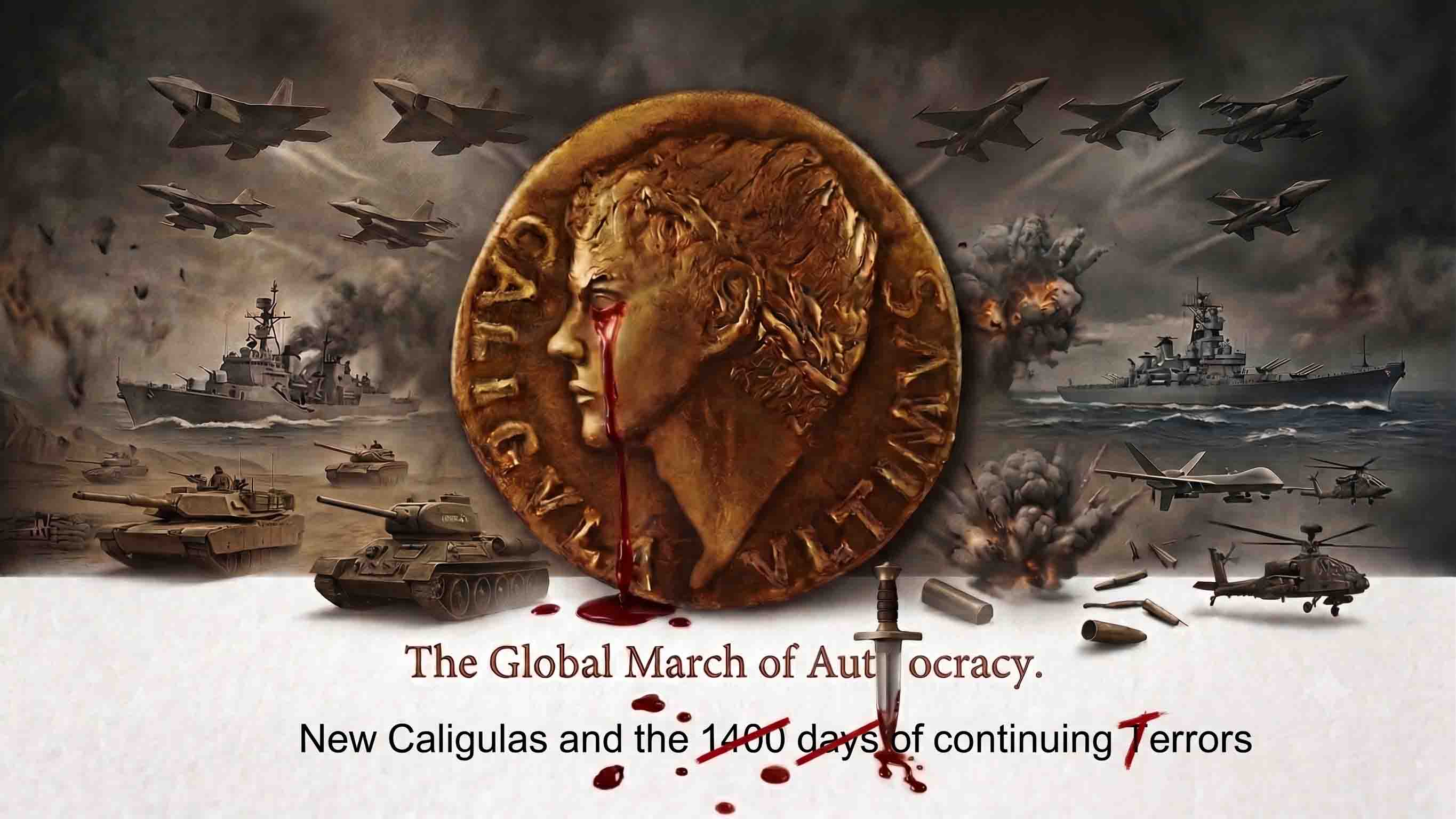
Madness unlimited. That is the mood of our age.
Republics are beginning to behave like empires. International law has not disappeared; it has merely become selectively obeyed. Wars no longer begin only after the slow failure of diplomacy. Increasingly, diplomacy is summoned after the missiles have already made the decision. A conflict can be opened by a leader, widened by an impulse and inherited by millions who were never consulted.
The mood has numbers. V-Dem's Democracy Report 2026 identifies 44 countries as autocratizing - almost one-quarter of the countries it studies. Together, they contain 3.4 billion people, or 41 per cent of humanity. Twenty-eight of those countries were democracies when their decline began; only 13 still remained democracies in 2025. Freedom House, looking through a different lens, reports that global freedom declined in 2025 for the twentieth consecutive year. Autocracy is no longer advancing only by overthrowing democracies. It is learning how to hollow them out from within. Autocrats do not always arrive in tanks. Many arrive through the ballot box, wrapped in the national flag, carrying a popular mandate - and then slowly teach the system to kneel.
This is the most dangerous form of modern autocracy. It does not necessarily abolish elections on its first day. It changes the meaning of power: the leader begins to stand above law; dissent becomes disloyalty; the press becomes an enemy; foreign policy becomes personal; and national greatness becomes a licence for permanent mobilisation.
Caligula belongs to ancient Rome; the Caligulan instinct does not. According to Suetonius, the emperor frequently repeated a line from the dramatist Accius:"Let them hate me, so long as they fear me." Modern autocrats rarely wear crowns, but fear remains their preferred currency. They measure authority not by the confidence of citizens, but by the silence of opponents and the anxiety of neighbours.
Vladimir Putin's full-scale invasion of Ukraine brought this politics of personal power into its most destructive contemporary form. By the end of June 2026, the UN Human Rights Office had verified at least 16,431 civilian deaths since February 2022; the real number is almost certainly higher. The war continues because the person who opened it cannot easily admit that its promised destination has disappeared.
Sudan presents the opposite tragedy: not an excess of global attention, but an absence of it. Millions have been displaced while rival armed centres of power tear the country apart. The world has developed a cruel habit of ranking human suffering according to strategic usefulness. Some deaths shake markets and summon summits. Others vanish into a paragraph at the bottom of the news.
The Middle East has become another theatre of decisions taken from above and paid for below. The United States and Israel attacked Iran in February 2026 after diplomacy failed over nuclear enrichment and ballistic missiles. Whatever arguments are advanced in the language of security, the larger pattern is unmistakable: executives act first, legislatures and international institutions struggle to catch up, and civilians inherit the consequences.
Donald Trump offers the clearest current example of an elected mandate being stretched into a claim of personal geopolitical licence. In January 2026, US forces entered Venezuela and captured Nicolas Maduro. Weeks later, Washington and Israel opened the war with Iran. Few elected leaders in recent memory have opened so many fronts so quickly. The question is not whether Maduro's rule was democratic or whether Iran poses security risks. The question is whether one powerful state, acting through one powerful leader, can appoint itself investigator, judge and executioner beyond its borders.
For the United States, the cost is larger than any single operation. Its greatest strength was never aircraft carriers alone; it was the belief that American power, however imperfectly, remained tied to constitutional restraint and an international order. V-Dem's 2026 report now lists the United States among the new autocratizing countries and describes the speed of its democratic decline as unprecedented. A republic may retain elections and still acquire imperial reflexes.
Elsewhere, the map is tightening. South Asia remains one conflict centre between nuclear- armed neighbors. From Pervez Musharraf's Kargil gamble to the Pulwama under Field Marshal Asim Munir, Pakistan’s autocratic military launches a conflict with India whenever a new general accents to the throne. Pakistan's civilian politics has repeatedly lived underthe long shadow of the barracks. Across the Taiwan Strait, China and Taiwan sit at the edge of another potentially global confrontation.
Recep Tayyip Erdogan moves from one capital to another - dealing with Russia, NATO, the Gulf monarchies and Asian powers - and converts strategic ambiguity into leverage. In August 2026, Saudi Arabia, Turkiye and Pakistan formalised a joint defence arrangement, with its first secretariat to be headed by a Pakistani secretary-general. Such arrangements may be presented as security architecture. Yet in a region saturated with fear, every new architecture can also become another fault line.
China’s Xi Jinping as a powerful leader, is a model for autocrats as the sophisticated iron man is leading his country from strength to strength.
Kim Jong Un represents its raw hereditary extreme - a nuclear-armed state in which threat itself has become a method of government. That he has not used his ultimate weapons is only a small comfort; deterrence built upon one man's judgment remains a permanent flash point.
The central failure, however, is institutional. The political systems that create these leaders often discover too late that they cannot control them. Constitutions do not enforce themselves. Courts cannot save a republic if their judgments are ignored; parliaments cannot restrain an executive if members are intimidated into obedience; a press cannot defend truth if it is bullied into self-censorship; and voters cannot preserve democracy if they exchange restraint for the intoxicating promise of national greatness.
This is also why autocrats struggle to close the conflicts they begin. Peace requires negotiation, compromise and the admission that an adversary has interests of its own. Autocratic theatre demands victory. Once a leader has built his image around infallibility, a negotiated end resembles personal defeat. Wars therefore continue even after their original purposes blur. Soldiers keep fighting, civilians keep dying and the leader keeps searching for a victory large enough to justify the losses already incurred.
James Madison understood this danger more than two centuries ago: "No nation could preserve its freedom in the midst of continual warfare. "War enlarges the executive, unlocks public treasuries, excuses secrecy and teaches citizens to accept extraordinary power as normal. The battlefield may be abroad, but the political damage eventually returns home.
A century ago, Hitler and Mussolini were not merely imposed upon silent populations; they were elevated by mass politics and cheered by millions who mistook aggression for strength. Their supporters assumed that violence would remain directed at enemies. It never does. Power released from restraint eventually turns inward.
History does not repeat itself every hundred years according to a clock. It repeats when memory weakens faster than ambition. Each generation believes that its institutions are more civilised, its citizens better informed and its leaders more manageable than those of the past. Then a crisis arrives, fear spreads, and people willingly hand exceptional power to someone who promises certainty.
Perhaps the animal is not hidden inside one nation, one ideology or one century. It is hidden inside human beings. Civilisation is not the absence of that animal; it is the cage built around it by law, institutions, memory and public courage. When we dismantle the cage because the animal promises greatness, we should not be surprised when it begins to feed on us. Caligula is gone. The temptation that produced him is not. It now wears a suit, contests elections, speaks in the name of the nation - and travels in a presidential aircraft.
(NB: This article is finetuned by AI)

Comments
No comments yet.
Please log in to comment.