
Banking
When AI assesses the borrower, the bank must respond
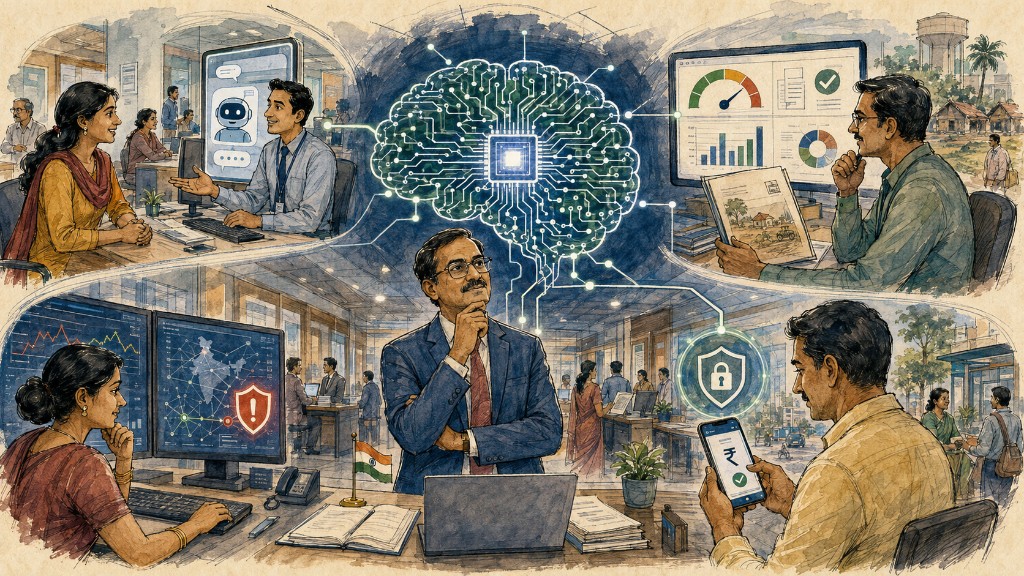
Artificial intelligence is entering almost every part of banking. It can answer questions of the customers, detect fraud, facilitate digital security, examine the documents, track transactions and predict whether the customer is going to default or not.
But banking is not like a conventional business service. It is a trust-oriented service delivery. Here, adapting and deploying frontier technology like AI need tremendous preparation.
At the same time, technology always is biased to its early users. That leaves a message to banks as well. They can't sit idle by saying a frontier technology like AI is risky.
Banks can't remain on the sidelines
The central banks' musings with the banks are continuous regarding AI adoption. Its approach is not discouragement. Rather the central bank is constantly encouraging banks not to stay away from technology and at the same time, it always gives nuanced warnings to be cautious while deploying it.
For example, the RBI Governor, Sanjay Malhotra reminded banks that AI is a capability to be responsibly harnessed rather than a risk to be contained. In the annual summit of FICCI-IBA the Governor reminded that Indian banks cannot sit on the sidelines in AI adoption.
The boundary up to which AI can be used in banking is yet to be drawn. A major area of AI in banking is automation that may be deployed across customer relationship and assessing creditworthiness.
Still an important business of banking ??? underwriting or finalising the loan approval by checking the creditworthiness of the client is yet to be left to AI. But at the same time, executives use considerable data and AI to identify the best client. That's it.
In India, the RBI is frequently issuing guidelines and warning to banks regarding the deployment of AI.
The Governor pointed that AI can be useful in credit delivery and operational efficiency. Data and credit history obtained digitally and analysed with the powerful tools can always be helpful for underwriting.
When formal books are not available to assess the creditworthiness of the client in the process of underwriting, cash flows, GST filings, utility payments and digital footprints can help.
This digital proof and the data analysis comes at a considerably low marginal cost and is very helpful in underwriting.
Still, the RBI is strict on the process of underwriting. Its regulatory instructions stipulate that underwriting is a manual responsibility. There should be a 'human in the loop.' Here AI can augment rather than replacing human judgement. The message is clear ??? AI is inevitable for banks to process the digital footprints and data. This may reduce cost and banks can use such a method to reduce the manual workload while human judgement should remain in the loop.

Comments
No comments yet.
Please log in to comment.